Lecture 13: Liquids - structure, surface tension, and capillarity
This lecture marks a shift in our focus, moving away from the classical thermodynamics we've just completed (including cycles, Carnot and Stirling engines, and entropy). That prior block of learning established how energy and temperature behave in various systems. Now, we return to exploring the fundamental "properties of matter," starting today with liquids, and then dedicating the final two lectures to solids.
We'll draw upon tools from our thermodynamics discussions, such as latent heats ($L_v$), the Boltzmann factor, and various energy scales, to understand the unique characteristics of liquids. Our plan for today is to build a clear picture of liquid structure by examining nearest neighbours and the radial distribution function. We'll then define surface tension macroscopically and link it to microscopic bond energies ($\varepsilon$). Finally, we'll explore capillary rise, understanding how surface tension and wettability explain phenomena like water climbing narrow tubes, and we'll develop simple quantitative models to estimate these effects.
# 1) What is a liquid? Macroscopic properties and energy balance
Liquids possess distinct physical characteristics. They are largely incompressible due to the steep, short-range repulsive forces between their molecules, which resist attempts to push them closer together. However, unlike solids, liquids are not rigid. This is because the attractive forces between molecules aren't strong enough to lock them into fixed positions, allowing molecules to flow past one another. Liquids also exhibit viscosity, meaning they resist shear forces but can still flow, with a viscosity typically much higher than that of a gas.
The liquid state is fundamentally defined by a delicate energy balance: the kinetic energies of its molecules are comparable to their bonding energies. If kinetic energies were much larger than bonding energies, free flight would dominate, and the substance would be a gas. Conversely, if kinetic energies were much smaller, molecules would merely vibrate about fixed positions, forming a solid. This comparable energy balance means molecules are mobile but remain cohesive. As a consequence, liquids typically exist over a relatively narrow temperature range. Beyond this range, either the kinetic energy becomes too high (leading to a gas) or too low (leading to a solid).
# 2) Nearest neighbours and structural order: liquids vs solids
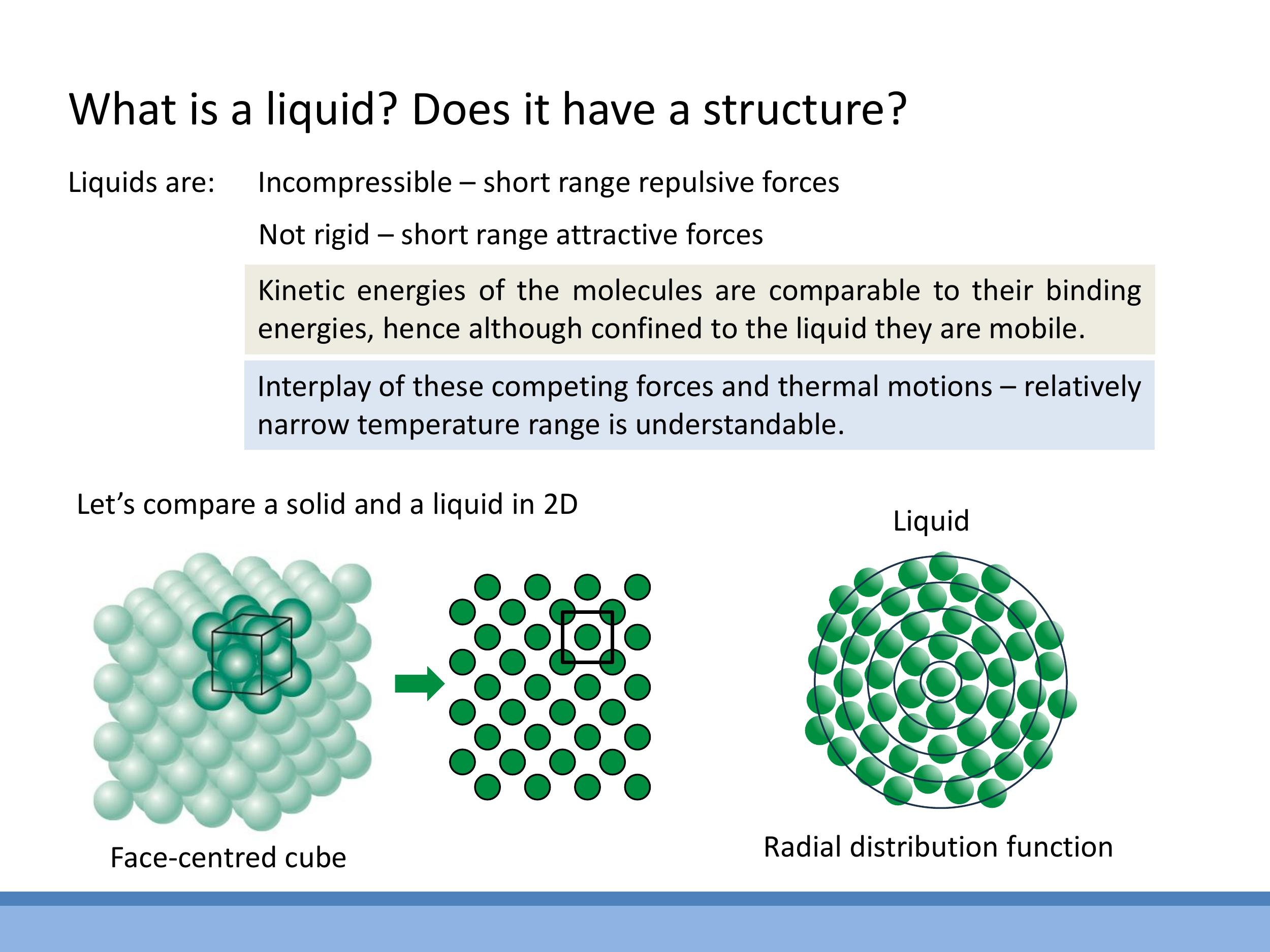
We can quantify the local arrangement of molecules by considering their "nearest neighbours," also known as coordination. In a typical liquid, the average number of nearest neighbours, $n$, is approximately 10 in three dimensions. This contrasts with a close-packed solid, such as a face-centred cubic (FCC) or hexagonal close-packed (HCP) structure, where each atom has exactly 12 nearest neighbours. Visualising this, a close-packed solid resembles stacked cannonballs in a highly ordered, repeating pattern.
The distinction between liquids and solids also lies in their long-range order. Crystalline solids exhibit a periodic, repeating arrangement where every atom "sees" the same local neighbourhood, leading to long-range order. In contrast, liquids possess only short-range order. While there's a discernible local arrangement around any given molecule, these local configurations vary from atom to atom, and the order rapidly dissipates over larger distances. It's worth noting that some solids, like glass, are amorphous and lack long-range order, displaying a structure that more closely resembles a liquid with only short-range order.
# 3) The radial distribution function g(r): measuring structure quantitatively
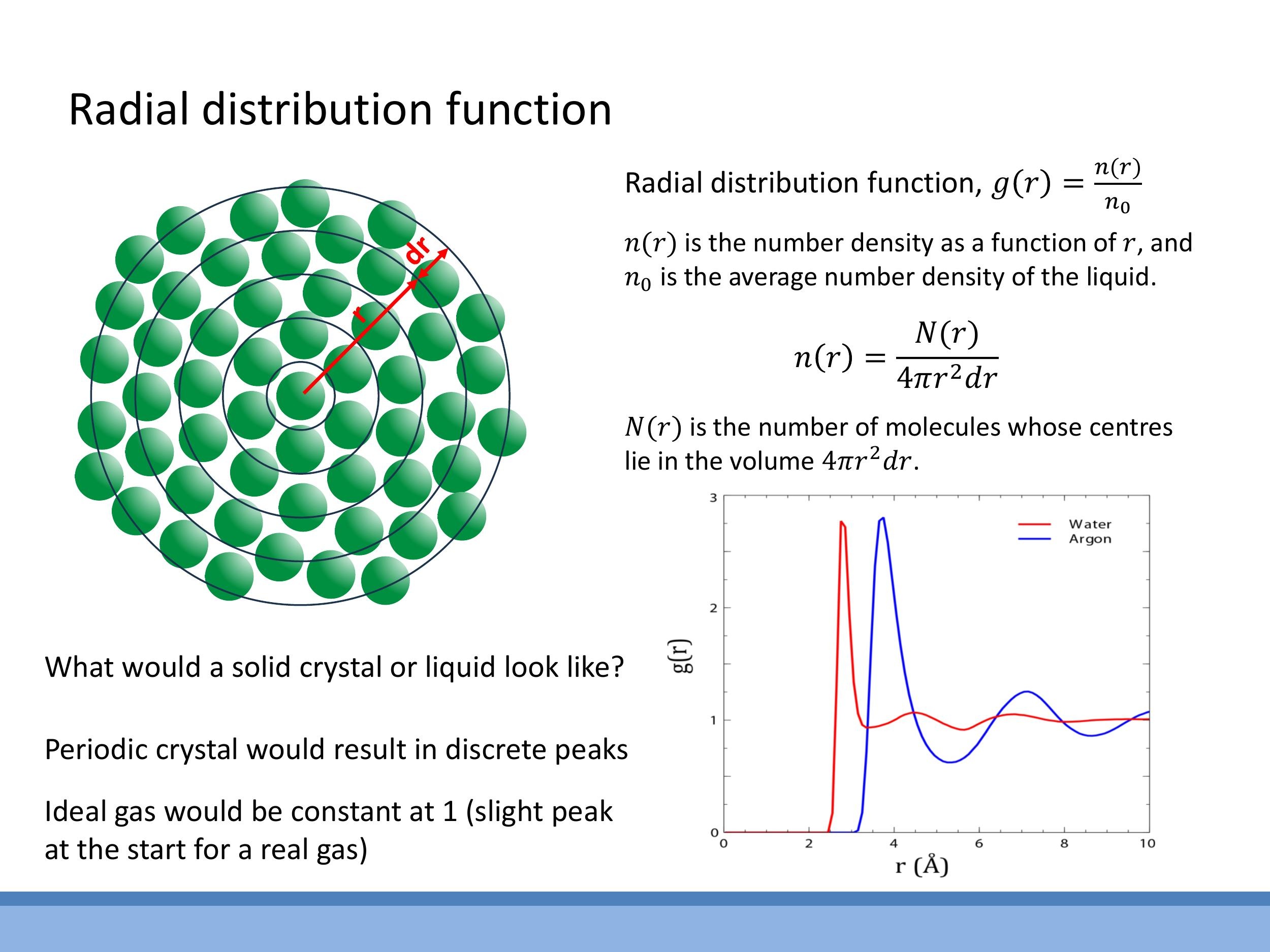
To quantitatively describe the structural order in a liquid, we use the radial distribution function, $g(r)$. This function is defined as the ratio of the local number density, $n(r)$, at a distance $r$ from a central atom, to the average number density of the liquid, $n_0$. Mathematically, this is expressed as:
$$
g(r) = \frac{n(r)}{n_0}
$$
where $n(r)$ is the density of molecules in a thin spherical shell of thickness $dr$ at a distance $r$, given by $n(r) = N(r) / (4\pi r^2 dr)$, and $N(r)$ is the number of molecules whose centres lie within that shell.
The qualitative signatures of $g(r)$ reveal much about the state of matter. For liquids, $g(r)$ shows a pronounced first peak, corresponding to the nearest neighbours. Subsequent peaks are typically broader and weaker, eventually damping out as $g(r)$ approaches 1 at large distances. This indicates the presence of short-range order that gradually fades, reflecting the lack of long-range periodicity. In contrast, a crystalline solid would display sharp, discrete peaks at fixed $r$ values, indicative of its long-range periodic structure. An ideal gas, where all separations are equally likely, would simply have $g(r) = 1$ for all $r$. A real gas would show a nearly flat $g(r)$ with only a slight short-range peak due to weak intermolecular interactions. When comparing liquids like water and argon, we observe that both show a strong first peak. However, water's hydrogen-bond network often shifts and sharpens its first coordination shell relative to simpler liquids like argon, highlighting the influence of specific bonding.
# 4) Surface tension γ: macroscopic definition and a simple film model
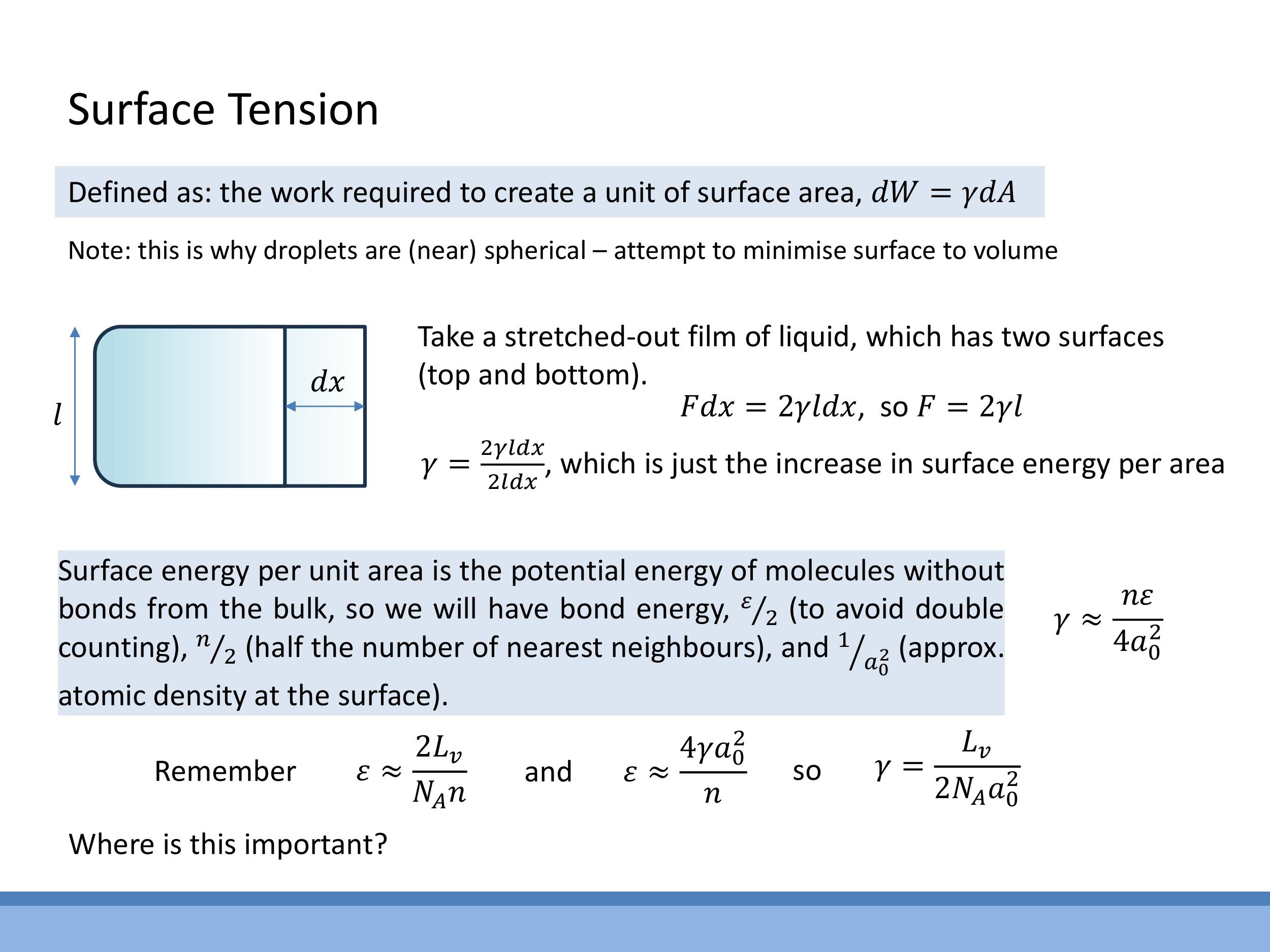
We can feel a distinct "tension" at the surface of a liquid. Macroscopically, surface tension, denoted $\gamma$, is defined as the work required to create a unit of surface area. This means that an infinitesimal amount of work, $dW$, is equal to $\gamma$ multiplied by the infinitesimal increase in surface area, $dA$:
$$
dW = \gamma dA
$$
This principle explains why liquid droplets tend to be spherical: by adopting this shape, they minimise their surface area for a given volume, thereby minimising their total surface energy.
To understand this quantitatively, consider a thin liquid film of width $l$ that is stretched by a small distance $dx$. Since the film has both a top and a bottom surface, two new surfaces are effectively created. The work done by the pulling force $F$ over the distance $dx$ must equal the increase in the film's total surface energy. This can be expressed as:
$$
F\,dx = \gamma (2l\,dx)
$$
From this, we can derive the force required to stretch the film:
$$
F = 2\gamma l
$$
This derivation confirms that surface tension $\gamma$ has the dimensions of energy per unit area (e.g., Joules per square metre, $\text{J} \, \text{m}^{-2} $) or, equivalently, force per unit length (e.g., Newtons per metre, $ \text{N} \, \text{m}^{-1}$).
# 5) Microscopic link: from γ to bond energy ε and back to L_v
At a microscopic level, surface energy arises because molecules at the surface of a liquid have fewer neighbours compared to those in the bulk. This means they have "missing bonds." We can approximate the surface tension $\gamma$ by considering the energy associated with these missing bonds. The missing-bond energy per molecule is roughly $\varepsilon/2$ (where $\varepsilon$ is the bond energy, and we divide by two to avoid double-counting each bond). The fraction of missing neighbours is approximately $n/2$ (where $n$ is the coordination number in the bulk), and the number density of molecules at the surface scales as $1/a_0^2$ (where $a_0$ is the atomic spacing). Combining these factors gives an approximate formula for surface tension:
$$
\gamma \approx \frac{n \varepsilon}{4 a_0^2}
$$
This equation provides a direct link between the macroscopic property of surface tension and the microscopic bond energy and atomic spacing.
We can cross-link this to earlier macroscopic measures. From our previous discussions on bonding, we derived a relationship between the bond energy $\varepsilon$ and the molar latent heat of vaporisation, $L_v$:
$$
\varepsilon \approx \frac{2 L_v}{N_A n}
$$
where $N_A$ is Avogadro's number. By rearranging the surface tension formula, we also get an estimate for $\varepsilon$ from surface tension:
$$
\varepsilon \approx \frac{4 \gamma a_0^2}{n}
$$
Equating these two expressions for $\varepsilon$ provides a powerful consistency check for our models and leads to a relationship connecting surface tension directly to latent heat:
$$
\gamma = \frac{L_v}{2 N_A a_0^2}
$$
As a worked example, consider liquid nitrogen. Given its surface tension $\gamma \approx 4 \times 10^{-3} \, \text{N} \, \text{m}^{-1} $, density $ \rho \approx 800 \, \text{kg} \, \text{m}^{-3} $, latent heat of vaporisation $ L_v \approx 5.6 \, \text{kJ} \, \text{mol}^{-1} $, and a coordination number $ n \approx 10 $, we can estimate $ a_0 $ from the density and molecular size. Using these values, the calculation from $ L_v $ yields $ \varepsilon \approx 0.012 \, \text{eV} $, while the calculation from $ \gamma $ yields $ \varepsilon \approx 0.016 \, \text{eV}$. The close agreement between these two independent, crude routes validates the underlying physical modelling to within factors of order unity.
# 6) Capillarity in the world: where surface tension matters
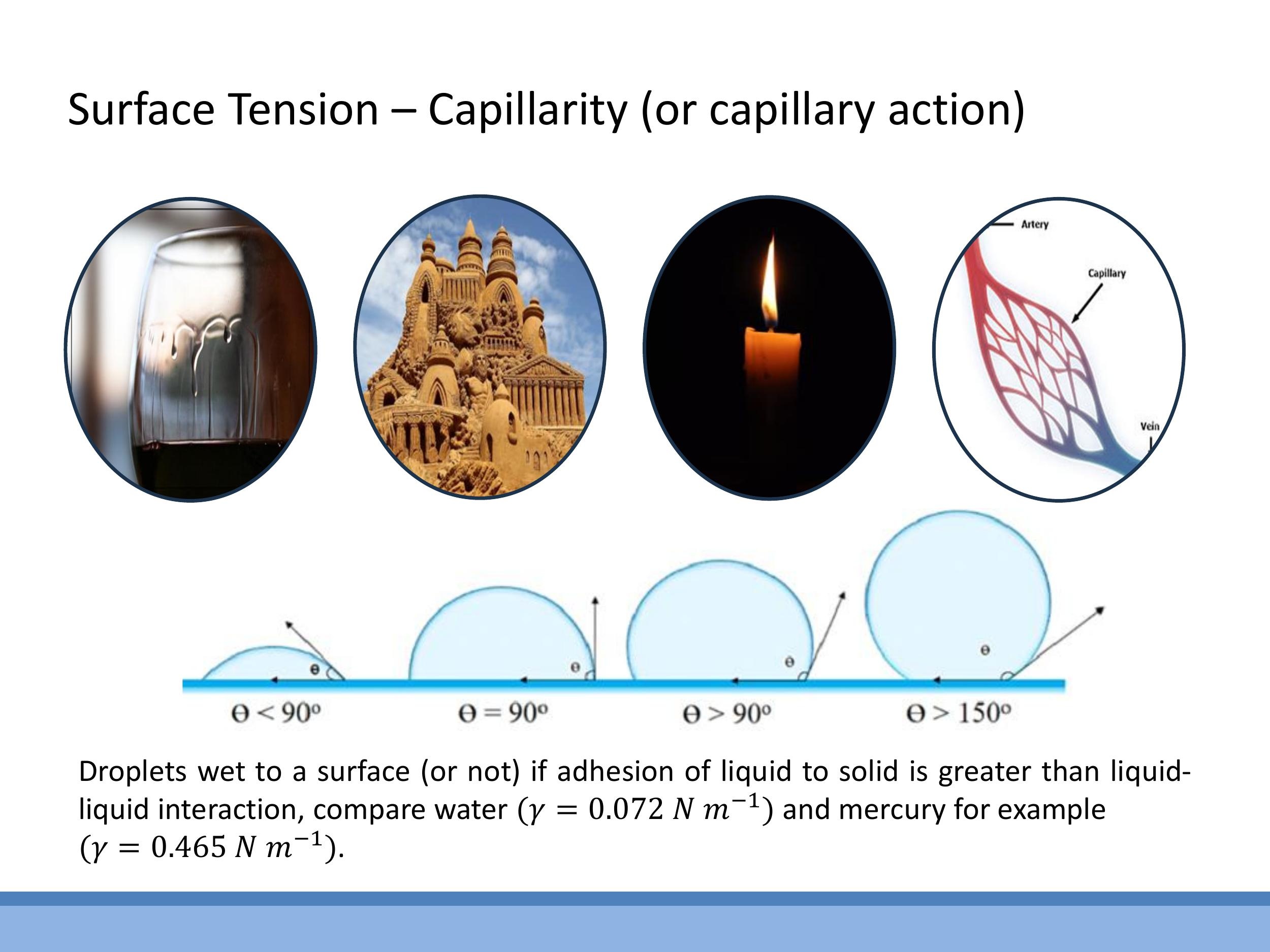
Surface tension plays a crucial role in many everyday phenomena and technological applications. For instance, the "tears of wine" that form on the inside of a glass are a result of differential surface tensions between alcohol and water, driving fluid flows. When building sandcastles, it's the surface tension of the water that binds individual sand grains, creating cohesive structures. In a candle, molten wax is drawn upwards by the wick through capillary action, where it then vaporises and burns; the wick acts as a transporter, not the primary fuel. Biologically, capillary networks rely on surface tension and wettability to move fluids throughout organisms.
The interaction between a liquid and a solid surface is described by its "wettability," quantified by the contact angle $\theta$. This angle reflects the balance between adhesive forces (liquid-solid interaction) and cohesive forces (liquid-liquid interaction). For example, water on clean glass exhibits excellent wetting, with a contact angle $\theta \approx 0^\circ$. In stark contrast, mercury on glass shows poor wetting, preferring to bond to itself, forming near-spherical droplets with a large contact angle. Typical surface tensions further highlight these differences: water has $\gamma_{\text{water}} \approx 0.072 \, \text{N} \, \text{m}^{-1} $, while mercury has a much higher $ \gamma_{\text{mercury}} \approx 0.465 \, \text{N} \, \text{m}^{-1}$.
# 7) Quantifying curvature: pressure jump across a curved surface
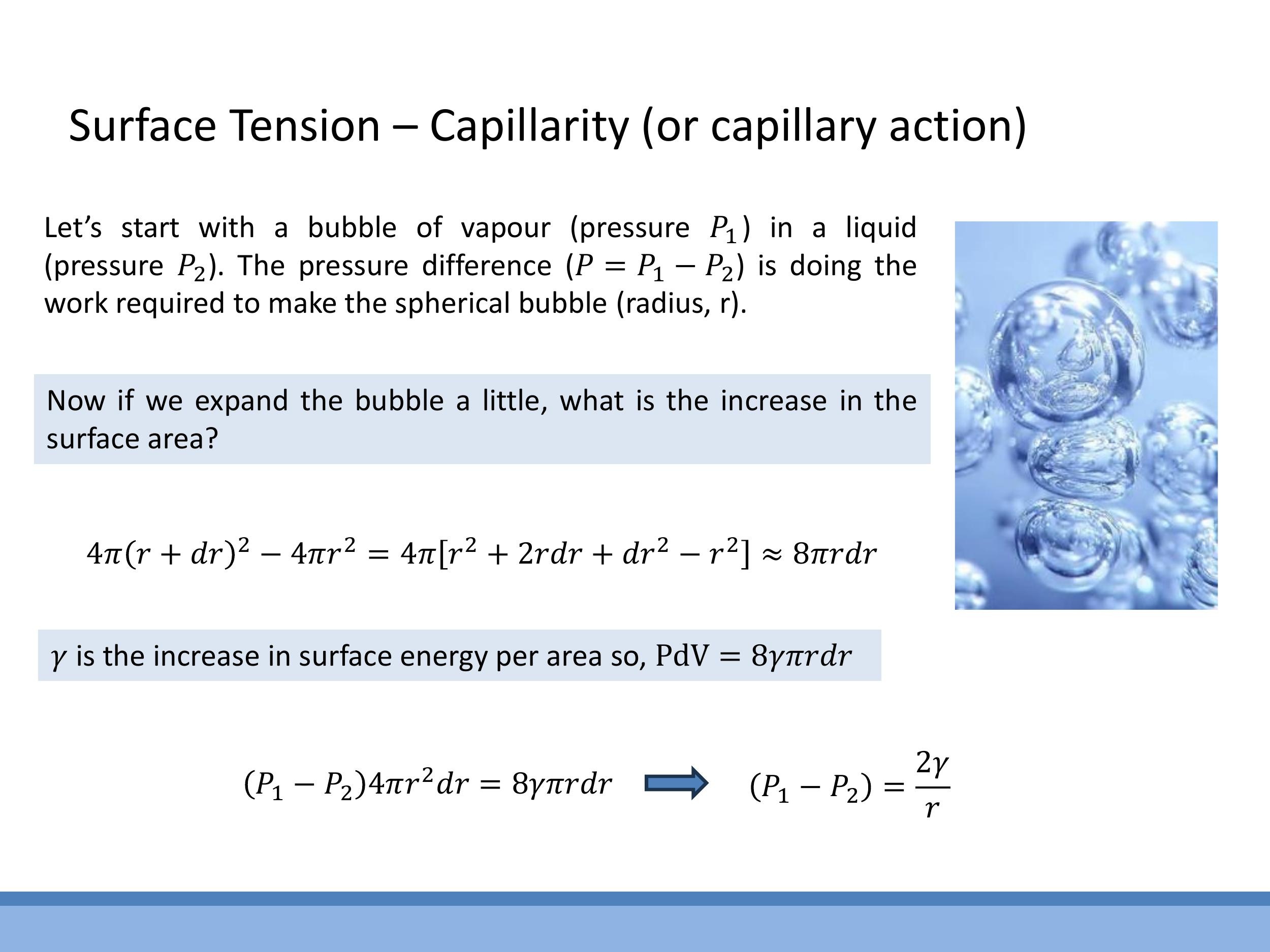
To understand capillary action quantitatively, we first need to quantify the pressure difference across a curved liquid interface. Consider a thought experiment with a vapour bubble (at pressure $P_1$) submerged in a liquid (at pressure $P_2$). If the bubble's radius increases by a small amount $dr$, its surface area increases by approximately $8\pi r \, dr $. The work done by the pressure difference ($ P_1 - P_2$) as the bubble expands is used to create this new surface area, increasing the surface energy.
By balancing the work done by the pressure difference ($P \, dV $) with the increase in surface energy ($ \gamma \, dA$), we arrive at the Laplace pressure equation for a spherical interface:
$$
(P_1 - P_2) = \frac{2\gamma}{r}
$$
This result indicates that a higher curvature (i.e., a smaller radius $r$) requires a larger pressure difference to sustain the interface. Physically, this means that the pressure inside a small bubble is greater than the pressure in the surrounding liquid.
# 8) Capillary rise: balancing surface forces with hydrostatic weight
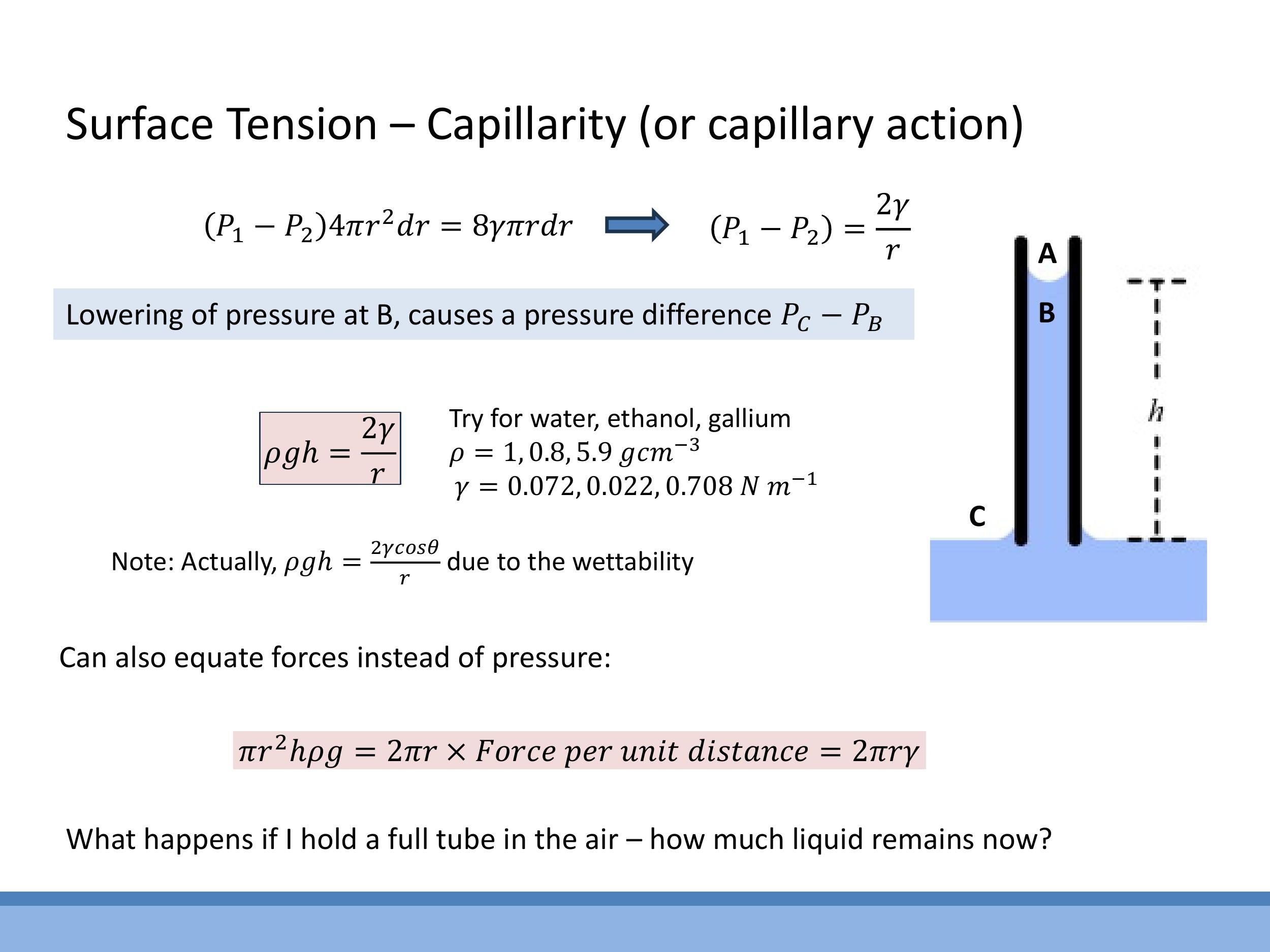
Capillary rise in a narrow tube is a direct consequence of surface tension and the Laplace pressure. The curved meniscus formed by the liquid inside the tube creates a lower pressure just beneath its surface, relative to the flat liquid surface in the reservoir outside. This pressure difference then supports a column of liquid of height $h$, which is balanced by the hydrostatic pressure of the fluid column itself.
We can derive the capillary rise height $h$ using two equivalent routes. The pressure route equates the hydrostatic head of the liquid column to the Laplace pressure. Assuming perfect wetting (contact angle $\theta = 0^\circ$, so $\cos\theta = 1$), this gives:
$$
\rho g h = \frac{2\gamma}{r}
$$
where $\rho$ is the liquid's density, $g$ is the acceleration due to gravity, and $r$ is the radius of the tube. The force route balances the upward force due to surface tension acting along the circumference of the meniscus ($2\pi r \gamma$) with the downward gravitational force of the liquid column ($\pi r^2 h \rho g$). Both methods yield the same result. For general wettability, where the contact angle $\theta$ is not zero, the formula is modified to include a $\cos\theta$ term:
$$
\rho g h = \frac{2\gamma \cos\theta}{r}
$$
This equation shows that the rise height $h$ is inversely proportional to the tube's radius ($h \propto 1/r$), meaning finer tubes will draw liquids higher. The presence of $\cos\theta$ also highlights the importance of wettability; if the liquid doesn't wet the tube (e.g., mercury in glass, $\theta > 90^\circ$), $\cos\theta$ becomes negative, and the liquid level will actually be depressed.
For typical magnitudes, water rises by several centimetres in sub-millimetre tubes. For example, if we consider water with $\gamma_{\text{water}} \approx 0.072 \, \text{N} \, \text{m}^{-1} $ and $ \rho_{\text{water}} \approx 1000 \, \text{kg} \, \text{m}^{-3} $ in a tube with radius $ r \approx 0.2 \, \text{mm} $ (or $ 2 \times 10^{-4} \, \text{m}$), we can calculate the rise height:
$$
h = \frac{2 \times 0.072\,\text{N}\,\text{m}^{-1}}{1000\,\text{kg}\,\text{m}^{-3} \times 9.81\,\text{m}\,\text{s}^{-2} \times 2 \times 10^{-4}\,\text{m}} \approx 0.073\,\text{m} = 7.3\,\text{cm}
$$
This centimetre-scale rise is readily observable. Liquids with different surface tensions and densities, such as ethanol or gallium, will exhibit different capillary behaviours.
⚠️ Exam Alert! The lecturer explicitly stated: "This is not unlike questions have been asked in multiple choice tests." You should be prepared to calculate capillary rise $h$ given the tube radius $r$, surface tension $\gamma$, liquid density $\rho$, and potentially the contact angle $\theta$.
The lecture also included a demonstration where a capillary tube was filled completely with water, and the lecturer asked how much liquid would remain if the tube was held in the air, without adding analysis beyond what was discussed about the forces at play.
# 9) Consolidation: linking micro, meso, and macro for liquids
This lecture has woven together microscopic, mesoscopic, and macroscopic perspectives to understand the behaviour of liquids.
Our exploration of liquid structure showed that liquids possess strong short-range order, characterised by a well-defined first coordination shell, but they lack the long-range periodicity found in crystalline solids. The radial distribution function, $g(r)$, quantitatively captures this, displaying a strong initial peak that gradually damps out to 1 at larger distances. We noted that typical coordination numbers, $n$, are around 10 in liquids, compared to 12 in close-packed solids.
In terms of energetics, we defined surface tension, $\gamma$, as the surface energy per unit area, expressed macroscopically as $dW = \gamma \, dA $. Microscopically, we linked this to the "missing bonds" at the surface, deriving an approximate relationship $ \gamma \approx (n \varepsilon)/(4 a_0^2) $, where $ \varepsilon $ is the bond energy and $ a_0 $ is the atomic spacing. Crucially, we demonstrated that independent estimates of $ \varepsilon $ derived from the latent heat of vaporisation ($ L_v$) and from surface tension, using crude geometric models, yield consistent order-of-magnitude values, as seen in the liquid nitrogen example. This reinforces the validity of our physical models.
Finally, we investigated capillarity, understanding that curved interfaces, such as a liquid meniscus, are associated with a Laplace pressure jump, $\Delta P = 2\gamma/r$. This pressure difference, when balanced by the hydrostatic pressure of a liquid column, explains capillary rise. The height of this rise, $h$, is given by $\rho g h = (2\gamma \cos\theta)/r$, demonstrating that narrower tubes lead to higher rises and that the contact angle, $\theta$, which quantifies wettability, plays a critical role. This entire process exemplifies the "model → estimate → check numbers" problem-solving habit, connecting fundamental principles to observable phenomena.
Key takeaways
Liquids are incompressible due to steep short-range repulsion and non-rigid because attractive forces aren't strong enough to lock atoms into fixed positions. Their defining characteristic is that molecular kinetic and binding energies are comparable.
Liquids typically have around $n \approx 10$ nearest neighbours, compared to $n = 12$ in close-packed solids. They exhibit short-range order but lack the long-range periodic order of crystalline solids.
The radial distribution function $g(r)$ quantifies this structure. For liquids, it shows a strong first peak and damped oscillations, eventually approaching 1 at large distances. In contrast, solids have sharp, discrete peaks, while an ideal gas is flat at 1.
Surface tension $\gamma$ is the work required to create unit surface area ($dW = \gamma \, dA $). A stretched-film model yields $ F = 2\gamma l $, and a "missing bonds" picture provides a microscopic link: $ \gamma \approx (n \varepsilon)/(4 a_0^2)$.
The bond energy per pair $\varepsilon$ is connected to the macroscopic latent heat of vaporisation $L_v$ by $\varepsilon \approx 2 L_v/(N_A n)$. Independent estimates of $\varepsilon$ from $L_v$ and $\gamma$ agree well, as demonstrated for liquid nitrogen.
Curved interfaces, like the meniscus in a capillary tube, create a Laplace pressure jump $\Delta P = 2\gamma/r$. Capillary rise results from balancing this pressure difference with the hydrostatic weight of the liquid column, leading to $\rho g h = (2\gamma \cos\theta)/r$. This equation shows that narrower tubes cause liquids to rise higher, and wettability (quantified by $\theta$) significantly influences the effect.
## Lecture 13: Liquids - structure, surface tension, and capillarity
This lecture marks a shift in our focus, moving away from the classical thermodynamics we've just completed (including cycles, Carnot and Stirling engines, and entropy). That prior block of learning established how energy and temperature behave in various systems. Now, we return to exploring the fundamental "properties of matter," starting today with liquids, and then dedicating the final two lectures to solids.
We'll draw upon tools from our thermodynamics discussions, such as latent heats ($L_v$), the Boltzmann factor, and various energy scales, to understand the unique characteristics of liquids. Our plan for today is to build a clear picture of liquid structure by examining nearest neighbours and the radial distribution function. We'll then define surface tension macroscopically and link it to microscopic bond energies ($\varepsilon$). Finally, we'll explore capillary rise, understanding how surface tension and wettability explain phenomena like water climbing narrow tubes, and we'll develop simple quantitative models to estimate these effects.
## # 1) What is a liquid? Macroscopic properties and energy balance

Liquids possess distinct physical characteristics. They are largely incompressible due to the steep, short-range repulsive forces between their molecules, which resist attempts to push them closer together. However, unlike solids, liquids are not rigid. This is because the attractive forces between molecules aren't strong enough to lock them into fixed positions, allowing molecules to flow past one another. Liquids also exhibit viscosity, meaning they resist shear forces but can still flow, with a viscosity typically much higher than that of a gas.
The liquid state is fundamentally defined by a delicate energy balance: the kinetic energies of its molecules are comparable to their bonding energies. If kinetic energies were much larger than bonding energies, free flight would dominate, and the substance would be a gas. Conversely, if kinetic energies were much smaller, molecules would merely vibrate about fixed positions, forming a solid. This comparable energy balance means molecules are mobile but remain cohesive. As a consequence, liquids typically exist over a relatively narrow temperature range. Beyond this range, either the kinetic energy becomes too high (leading to a gas) or too low (leading to a solid).
## # 2) Nearest neighbours and structural order: liquids vs solids

We can quantify the local arrangement of molecules by considering their "nearest neighbours," also known as coordination. In a typical liquid, the average number of nearest neighbours, $n$, is approximately 10 in three dimensions. This contrasts with a close-packed solid, such as a face-centred cubic (FCC) or hexagonal close-packed (HCP) structure, where each atom has exactly 12 nearest neighbours. Visualising this, a close-packed solid resembles stacked cannonballs in a highly ordered, repeating pattern.
The distinction between liquids and solids also lies in their long-range order. Crystalline solids exhibit a periodic, repeating arrangement where every atom "sees" the same local neighbourhood, leading to long-range order. In contrast, liquids possess only short-range order. While there's a discernible local arrangement around any given molecule, these local configurations vary from atom to atom, and the order rapidly dissipates over larger distances. It's worth noting that some solids, like glass, are amorphous and lack long-range order, displaying a structure that more closely resembles a liquid with only short-range order.
## # 3) The radial distribution function g(r): measuring structure quantitatively

To quantitatively describe the structural order in a liquid, we use the radial distribution function, $g(r)$. This function is defined as the ratio of the local number density, $n(r)$, at a distance $r$ from a central atom, to the average number density of the liquid, $n_0$. Mathematically, this is expressed as:
$$ g(r) = \frac{n(r)}{n_0} $$
where $n(r)$ is the density of molecules in a thin spherical shell of thickness $dr$ at a distance $r$, given by $n(r) = N(r) / (4\pi r^2 dr)$, and $N(r)$ is the number of molecules whose centres lie within that shell.
The qualitative signatures of $g(r)$ reveal much about the state of matter. For liquids, $g(r)$ shows a pronounced first peak, corresponding to the nearest neighbours. Subsequent peaks are typically broader and weaker, eventually damping out as $g(r)$ approaches 1 at large distances. This indicates the presence of short-range order that gradually fades, reflecting the lack of long-range periodicity. In contrast, a crystalline solid would display sharp, discrete peaks at fixed $r$ values, indicative of its long-range periodic structure. An ideal gas, where all separations are equally likely, would simply have $g(r) = 1$ for all $r$. A real gas would show a nearly flat $g(r)$ with only a slight short-range peak due to weak intermolecular interactions. When comparing liquids like water and argon, we observe that both show a strong first peak. However, water's hydrogen-bond network often shifts and sharpens its first coordination shell relative to simpler liquids like argon, highlighting the influence of specific bonding.
## # 4) Surface tension γ: macroscopic definition and a simple film model

We can feel a distinct "tension" at the surface of a liquid. Macroscopically, surface tension, denoted $\gamma$, is defined as the work required to create a unit of surface area. This means that an infinitesimal amount of work, $dW$, is equal to $\gamma$ multiplied by the infinitesimal increase in surface area, $dA$:
$$ dW = \gamma dA $$
This principle explains why liquid droplets tend to be spherical: by adopting this shape, they minimise their surface area for a given volume, thereby minimising their total surface energy.
To understand this quantitatively, consider a thin liquid film of width $l$ that is stretched by a small distance $dx$. Since the film has both a top and a bottom surface, two new surfaces are effectively created. The work done by the pulling force $F$ over the distance $dx$ must equal the increase in the film's total surface energy. This can be expressed as:
$$ F\,dx = \gamma (2l\,dx) $$
From this, we can derive the force required to stretch the film:
$$ F = 2\gamma l $$
This derivation confirms that surface tension $\gamma$ has the dimensions of energy per unit area (e.g., Joules per square metre, $\text{J}\,\text{m}^{-2}$) or, equivalently, force per unit length (e.g., Newtons per metre, $\text{N}\,\text{m}^{-1}$).
## # 5) Microscopic link: from γ to bond energy ε and back to L_v

At a microscopic level, surface energy arises because molecules at the surface of a liquid have fewer neighbours compared to those in the bulk. This means they have "missing bonds." We can approximate the surface tension $\gamma$ by considering the energy associated with these missing bonds. The missing-bond energy per molecule is roughly $\varepsilon/2$ (where $\varepsilon$ is the bond energy, and we divide by two to avoid double-counting each bond). The fraction of missing neighbours is approximately $n/2$ (where $n$ is the coordination number in the bulk), and the number density of molecules at the surface scales as $1/a_0^2$ (where $a_0$ is the atomic spacing). Combining these factors gives an approximate formula for surface tension:
$$ \gamma \approx \frac{n \varepsilon}{4 a_0^2} $$
This equation provides a direct link between the macroscopic property of surface tension and the microscopic bond energy and atomic spacing.
We can cross-link this to earlier macroscopic measures. From our previous discussions on bonding, we derived a relationship between the bond energy $\varepsilon$ and the molar latent heat of vaporisation, $L_v$:
$$ \varepsilon \approx \frac{2 L_v}{N_A n} $$
where $N_A$ is Avogadro's number. By rearranging the surface tension formula, we also get an estimate for $\varepsilon$ from surface tension:
$$ \varepsilon \approx \frac{4 \gamma a_0^2}{n} $$
Equating these two expressions for $\varepsilon$ provides a powerful consistency check for our models and leads to a relationship connecting surface tension directly to latent heat:
$$ \gamma = \frac{L_v}{2 N_A a_0^2} $$
As a worked example, consider liquid nitrogen. Given its surface tension $\gamma \approx 4 \times 10^{-3}\,\text{N}\,\text{m}^{-1}$, density $\rho \approx 800\,\text{kg}\,\text{m}^{-3}$, latent heat of vaporisation $L_v \approx 5.6\,\text{kJ}\,\text{mol}^{-1}$, and a coordination number $n \approx 10$, we can estimate $a_0$ from the density and molecular size. Using these values, the calculation from $L_v$ yields $\varepsilon \approx 0.012\,\text{eV}$, while the calculation from $\gamma$ yields $\varepsilon \approx 0.016\,\text{eV}$. The close agreement between these two independent, crude routes validates the underlying physical modelling to within factors of order unity.
## # 6) Capillarity in the world: where surface tension matters

Surface tension plays a crucial role in many everyday phenomena and technological applications. For instance, the "tears of wine" that form on the inside of a glass are a result of differential surface tensions between alcohol and water, driving fluid flows. When building sandcastles, it's the surface tension of the water that binds individual sand grains, creating cohesive structures. In a candle, molten wax is drawn upwards by the wick through capillary action, where it then vaporises and burns; the wick acts as a transporter, not the primary fuel. Biologically, capillary networks rely on surface tension and wettability to move fluids throughout organisms.
The interaction between a liquid and a solid surface is described by its "wettability," quantified by the contact angle $\theta$. This angle reflects the balance between adhesive forces (liquid-solid interaction) and cohesive forces (liquid-liquid interaction). For example, water on clean glass exhibits excellent wetting, with a contact angle $\theta \approx 0^\circ$. In stark contrast, mercury on glass shows poor wetting, preferring to bond to itself, forming near-spherical droplets with a large contact angle. Typical surface tensions further highlight these differences: water has $\gamma_{\text{water}} \approx 0.072\,\text{N}\,\text{m}^{-1}$, while mercury has a much higher $\gamma_{\text{mercury}} \approx 0.465\,\text{N}\,\text{m}^{-1}$.
## # 7) Quantifying curvature: pressure jump across a curved surface

To understand capillary action quantitatively, we first need to quantify the pressure difference across a curved liquid interface. Consider a thought experiment with a vapour bubble (at pressure $P_1$) submerged in a liquid (at pressure $P_2$). If the bubble's radius increases by a small amount $dr$, its surface area increases by approximately $8\pi r\,dr$. The work done by the pressure difference ($P_1 - P_2$) as the bubble expands is used to create this new surface area, increasing the surface energy.
By balancing the work done by the pressure difference ($P\,dV$) with the increase in surface energy ($\gamma\,dA$), we arrive at the Laplace pressure equation for a spherical interface:
$$ (P_1 - P_2) = \frac{2\gamma}{r} $$
This result indicates that a higher curvature (i.e., a smaller radius $r$) requires a larger pressure difference to sustain the interface. Physically, this means that the pressure inside a small bubble is greater than the pressure in the surrounding liquid.
## # 8) Capillary rise: balancing surface forces with hydrostatic weight

Capillary rise in a narrow tube is a direct consequence of surface tension and the Laplace pressure. The curved meniscus formed by the liquid inside the tube creates a lower pressure just beneath its surface, relative to the flat liquid surface in the reservoir outside. This pressure difference then supports a column of liquid of height $h$, which is balanced by the hydrostatic pressure of the fluid column itself.
We can derive the capillary rise height $h$ using two equivalent routes. The pressure route equates the hydrostatic head of the liquid column to the Laplace pressure. Assuming perfect wetting (contact angle $\theta = 0^\circ$, so $\cos\theta = 1$), this gives:
$$ \rho g h = \frac{2\gamma}{r} $$
where $\rho$ is the liquid's density, $g$ is the acceleration due to gravity, and $r$ is the radius of the tube. The force route balances the upward force due to surface tension acting along the circumference of the meniscus ($2\pi r \gamma$) with the downward gravitational force of the liquid column ($\pi r^2 h \rho g$). Both methods yield the same result. For general wettability, where the contact angle $\theta$ is not zero, the formula is modified to include a $\cos\theta$ term:
$$ \rho g h = \frac{2\gamma \cos\theta}{r} $$
This equation shows that the rise height $h$ is inversely proportional to the tube's radius ($h \propto 1/r$), meaning finer tubes will draw liquids higher. The presence of $\cos\theta$ also highlights the importance of wettability; if the liquid doesn't wet the tube (e.g., mercury in glass, $\theta > 90^\circ$), $\cos\theta$ becomes negative, and the liquid level will actually be depressed.
For typical magnitudes, water rises by several centimetres in sub-millimetre tubes. For example, if we consider water with $\gamma_{\text{water}} \approx 0.072\,\text{N}\,\text{m}^{-1}$ and $\rho_{\text{water}} \approx 1000\,\text{kg}\,\text{m}^{-3}$ in a tube with radius $r \approx 0.2\,\text{mm}$ (or $2 \times 10^{-4}\,\text{m}$), we can calculate the rise height:
$$ h = \frac{2 \times 0.072\,\text{N}\,\text{m}^{-1}}{1000\,\text{kg}\,\text{m}^{-3} \times 9.81\,\text{m}\,\text{s}^{-2} \times 2 \times 10^{-4}\,\text{m}} \approx 0.073\,\text{m} = 7.3\,\text{cm} $$
This centimetre-scale rise is readily observable. Liquids with different surface tensions and densities, such as ethanol or gallium, will exhibit different capillary behaviours.
> **⚠️ Exam Alert!** The lecturer explicitly stated: "This is not unlike questions have been asked in multiple choice tests." You should be prepared to calculate capillary rise $h$ given the tube radius $r$, surface tension $\gamma$, liquid density $\rho$, and potentially the contact angle $\theta$.
The lecture also included a demonstration where a capillary tube was filled completely with water, and the lecturer asked how much liquid would remain if the tube was held in the air, without adding analysis beyond what was discussed about the forces at play.
## # 9) Consolidation: linking micro, meso, and macro for liquids
This lecture has woven together microscopic, mesoscopic, and macroscopic perspectives to understand the behaviour of liquids.
Our exploration of liquid **structure** showed that liquids possess strong short-range order, characterised by a well-defined first coordination shell, but they lack the long-range periodicity found in crystalline solids. The radial distribution function, $g(r)$, quantitatively captures this, displaying a strong initial peak that gradually damps out to 1 at larger distances. We noted that typical coordination numbers, $n$, are around 10 in liquids, compared to 12 in close-packed solids.
In terms of **energetics**, we defined surface tension, $\gamma$, as the surface energy per unit area, expressed macroscopically as $dW = \gamma\,dA$. Microscopically, we linked this to the "missing bonds" at the surface, deriving an approximate relationship $\gamma \approx (n \varepsilon)/(4 a_0^2)$, where $\varepsilon$ is the bond energy and $a_0$ is the atomic spacing. Crucially, we demonstrated that independent estimates of $\varepsilon$ derived from the latent heat of vaporisation ($L_v$) and from surface tension, using crude geometric models, yield consistent order-of-magnitude values, as seen in the liquid nitrogen example. This reinforces the validity of our physical models.
Finally, we investigated **capillarity**, understanding that curved interfaces, such as a liquid meniscus, are associated with a Laplace pressure jump, $\Delta P = 2\gamma/r$. This pressure difference, when balanced by the hydrostatic pressure of a liquid column, explains capillary rise. The height of this rise, $h$, is given by $\rho g h = (2\gamma \cos\theta)/r$, demonstrating that narrower tubes lead to higher rises and that the contact angle, $\theta$, which quantifies wettability, plays a critical role. This entire process exemplifies the "model → estimate → check numbers" problem-solving habit, connecting fundamental principles to observable phenomena.
## Key takeaways
Liquids are incompressible due to steep short-range repulsion and non-rigid because attractive forces aren't strong enough to lock atoms into fixed positions. Their defining characteristic is that molecular kinetic and binding energies are comparable.
Liquids typically have around $n \approx 10$ nearest neighbours, compared to $n = 12$ in close-packed solids. They exhibit short-range order but lack the long-range periodic order of crystalline solids.
The radial distribution function $g(r)$ quantifies this structure. For liquids, it shows a strong first peak and damped oscillations, eventually approaching 1 at large distances. In contrast, solids have sharp, discrete peaks, while an ideal gas is flat at 1.
Surface tension $\gamma$ is the work required to create unit surface area ($dW = \gamma\,dA$). A stretched-film model yields $F = 2\gamma l$, and a "missing bonds" picture provides a microscopic link: $\gamma \approx (n \varepsilon)/(4 a_0^2)$.
The bond energy per pair $\varepsilon$ is connected to the macroscopic latent heat of vaporisation $L_v$ by $\varepsilon \approx 2 L_v/(N_A n)$. Independent estimates of $\varepsilon$ from $L_v$ and $\gamma$ agree well, as demonstrated for liquid nitrogen.
Curved interfaces, like the meniscus in a capillary tube, create a Laplace pressure jump $\Delta P = 2\gamma/r$. Capillary rise results from balancing this pressure difference with the hydrostatic weight of the liquid column, leading to $\rho g h = (2\gamma \cos\theta)/r$. This equation shows that narrower tubes cause liquids to rise higher, and wettability (quantified by $\theta$) significantly influences the effect.